Tibir: Fighting Art of the Cobra and Mongoose
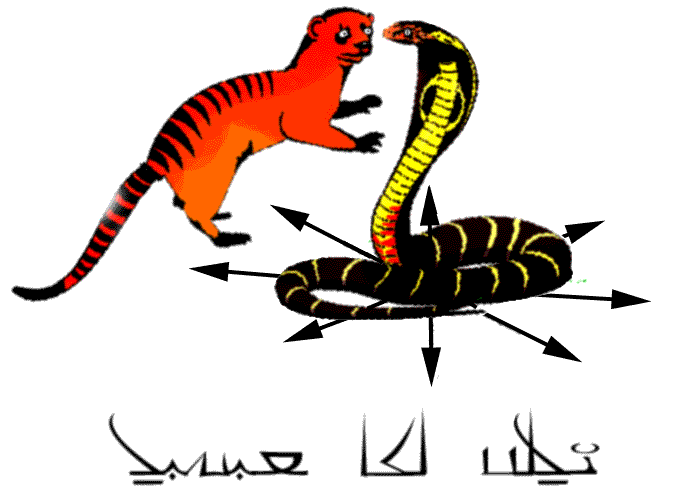
Below is info on the fundamental structure of
Tibir, for a illustrated page on Basic Tibir Click here.
KATU
the first posture, we stand like a mongoose
the first posture, we stand like a mongoose

THE SPLIT
One bursts forward striking as the cobra
One bursts forward striking as the cobra

THE FUNDAMENTAL STRUCTURE OF TIBIR:
I. THE WHITE PALM:
The word tibir implies the palm as well as a small knife. As implied by the name this is a palm based method of fighting and takes a gentler approach to self defense.
1A. The Four Strong Tibir (handshapes):
1) turtle hand is cupped with the palm facing the body, it is likened to the turtle's shell
2) carp hand is palm forward and digits spread and liked to the curve of a carp's tail when it turns in the water
3) cobra hand is palm forward with thumb and finger together. It is held at 45 degrees and is likened to a cobra's head and hood
4) swallow hand is palm up and when in motion is likened to the whirling twisting flight of the house swallow
1B. The Four Strong of Tibira (armshapes):
1) auroch, the arms are curved like bull horns
2) scorpion, one arm is arched like the scorpion's tail and the other is held close to the body like his claws
3) ram The fists are raised and the elbows bent, the elbows point forward and down so the arms are shaped like a pair of Ram's horns
4) falcon, the arms are bent at elbow and wrist. The elbows are folded to the body with the palms up, the impression is likened to the way a falcon folds his winds to dive.
1C. The Four Strong Ngir (leg postures):
1) mongoose, the knees-in posture replicated that manner in which 4 legged animals stand upright
2) anzu (roc), the front leg is extended with little weight on it while the rear leg remains bent. It gives the impression of a bird of prey walking
3) leopard, in Assyrian art, the leopard is usually shown stretched along the ground stalking. The leopard legs are the front horse of chinese martial arts (weight over front foot, rear leg out straight)
4) duck, the knees-out / feet-out posture is likened to the splayed feet of a duck as he walks
1D. The Four Strong Ngiri (stepping methods):
1) bear, the steps are made by shifting the hip and catching the weight on the foot. (done in mongoose ngir)
2) rooster The stepping leg reaches out and is placed before shifting the hips forward (thus transferring the weight to the front foot, done in the Roc ngir)
3) horse, the hips travel forward as the foot steps, the rea leg trails (done in the leopard gnir)
4) gazelle The foot lifts up to the knee before stepping or kicking forward and is likened to the way a walking gazelle lifts its hooves (done with duck ngir)
II. THE RED FIST:
The red fist is a special method of striking, in which the fist is closed at the last second. One who develops this technique can develop devastatingly powerful blows in the distance of one hand length or less.
1A. The Four Strong Tibir (handshapes):
1) eagle, the turtle tibir is rolled over (palm down) and the fist snaps shut, it is liked to the way a eagle snatches a fish from the water
2) moth, the carp tibir rolls over palm up and snaps closed, it the rolls back and opens. The effect is a blur of open and close that is like the fluttering of a moths wings when seen at right in front of your face
3) lion, cobra tibir rolls over (palm up) and snaps shut, it is likened to the way a lion shakes his mane
4) heron, swallow tibir rolls over (palm down) and the middle row of knuckles snap into the target. it is done as the arm falls so it is likened to how a heron strikes down at a fish.
1B. The Four Strong Tibira (armshapes):
1) smiting (bull, this is gust like Auroch above but energy is spreading rather than condensing as in Aurroch
2) ibix this ibix has long sharp curved horns that are saber shaped. in this tibira the arm is arc like the ibex horns and the hand thrusts in the way an ibix gores
3) owl, the elbow in compression strike is done with a short whip of the hip. The arms fold to this position after full extension so it is likened to a owl folding his wings
4) swan, the arms arch like the neck of the swan.
1C. The Four Strong Ngir (leg postures):
1) elephant, still knee in but we turn to one side, in this posture the knees are close. The legs take on the shape of the fron legs of an elephant. Likewise the focus of this posture is downward weight on the front foot and is likened to an elephant leaning into a tree or boulder
2) crab, the sideways stepping posture it like a crab's motion
3) lioness, this posture with the knees flexed and closed is reminiscent of the seated lioness depicted as a symbol of one of the goddesses
4) stag, the legs open wind with the shape of a jumping roe deer
1D. The Four Strong Ngiri (stepping methods):
1) watch dog, done with elephant gnir this step moves forward in short twisting steps and is likened to an assyrian mastiff sidling forward in a threatening manner.
2) alley cat, the twisting shift and step are likened to the way a an ally cat stretches when rubbing against a doorpost or leg
3) cricket, the forward burst and shuffle up of this step is likened to the way a desert cricket hops
4) butterfly, this step is symmetrical with knees opening outward and then closing again in the same manner as a butterfly opens its wing and then folds them
III. THE DANCE:
The dance is the form of pre-arranged stepping sequences in tibir. Tibir's form is small compared to many styles of martial arts.
I. THE WHITE PALM:
The word tibir implies the palm as well as a small knife. As implied by the name this is a palm based method of fighting and takes a gentler approach to self defense.
1A. The Four Strong Tibir (handshapes):
1) turtle hand is cupped with the palm facing the body, it is likened to the turtle's shell
2) carp hand is palm forward and digits spread and liked to the curve of a carp's tail when it turns in the water
3) cobra hand is palm forward with thumb and finger together. It is held at 45 degrees and is likened to a cobra's head and hood
4) swallow hand is palm up and when in motion is likened to the whirling twisting flight of the house swallow
1B. The Four Strong of Tibira (armshapes):
1) auroch, the arms are curved like bull horns
2) scorpion, one arm is arched like the scorpion's tail and the other is held close to the body like his claws
3) ram The fists are raised and the elbows bent, the elbows point forward and down so the arms are shaped like a pair of Ram's horns
4) falcon, the arms are bent at elbow and wrist. The elbows are folded to the body with the palms up, the impression is likened to the way a falcon folds his winds to dive.
1C. The Four Strong Ngir (leg postures):
1) mongoose, the knees-in posture replicated that manner in which 4 legged animals stand upright
2) anzu (roc), the front leg is extended with little weight on it while the rear leg remains bent. It gives the impression of a bird of prey walking
3) leopard, in Assyrian art, the leopard is usually shown stretched along the ground stalking. The leopard legs are the front horse of chinese martial arts (weight over front foot, rear leg out straight)
4) duck, the knees-out / feet-out posture is likened to the splayed feet of a duck as he walks
1D. The Four Strong Ngiri (stepping methods):
1) bear, the steps are made by shifting the hip and catching the weight on the foot. (done in mongoose ngir)
2) rooster The stepping leg reaches out and is placed before shifting the hips forward (thus transferring the weight to the front foot, done in the Roc ngir)
3) horse, the hips travel forward as the foot steps, the rea leg trails (done in the leopard gnir)
4) gazelle The foot lifts up to the knee before stepping or kicking forward and is likened to the way a walking gazelle lifts its hooves (done with duck ngir)
II. THE RED FIST:
The red fist is a special method of striking, in which the fist is closed at the last second. One who develops this technique can develop devastatingly powerful blows in the distance of one hand length or less.
1A. The Four Strong Tibir (handshapes):
1) eagle, the turtle tibir is rolled over (palm down) and the fist snaps shut, it is liked to the way a eagle snatches a fish from the water
2) moth, the carp tibir rolls over palm up and snaps closed, it the rolls back and opens. The effect is a blur of open and close that is like the fluttering of a moths wings when seen at right in front of your face
3) lion, cobra tibir rolls over (palm up) and snaps shut, it is likened to the way a lion shakes his mane
4) heron, swallow tibir rolls over (palm down) and the middle row of knuckles snap into the target. it is done as the arm falls so it is likened to how a heron strikes down at a fish.
1B. The Four Strong Tibira (armshapes):
1) smiting (bull, this is gust like Auroch above but energy is spreading rather than condensing as in Aurroch
2) ibix this ibix has long sharp curved horns that are saber shaped. in this tibira the arm is arc like the ibex horns and the hand thrusts in the way an ibix gores
3) owl, the elbow in compression strike is done with a short whip of the hip. The arms fold to this position after full extension so it is likened to a owl folding his wings
4) swan, the arms arch like the neck of the swan.
1C. The Four Strong Ngir (leg postures):
1) elephant, still knee in but we turn to one side, in this posture the knees are close. The legs take on the shape of the fron legs of an elephant. Likewise the focus of this posture is downward weight on the front foot and is likened to an elephant leaning into a tree or boulder
2) crab, the sideways stepping posture it like a crab's motion
3) lioness, this posture with the knees flexed and closed is reminiscent of the seated lioness depicted as a symbol of one of the goddesses
4) stag, the legs open wind with the shape of a jumping roe deer
1D. The Four Strong Ngiri (stepping methods):
1) watch dog, done with elephant gnir this step moves forward in short twisting steps and is likened to an assyrian mastiff sidling forward in a threatening manner.
2) alley cat, the twisting shift and step are likened to the way a an ally cat stretches when rubbing against a doorpost or leg
3) cricket, the forward burst and shuffle up of this step is likened to the way a desert cricket hops
4) butterfly, this step is symmetrical with knees opening outward and then closing again in the same manner as a butterfly opens its wing and then folds them
III. THE DANCE:
The dance is the form of pre-arranged stepping sequences in tibir. Tibir's form is small compared to many styles of martial arts.
3A. The Dance (steps in sequence):
Positive & Negative (one posture each):
a. Katu (fallen) (an earth posture with the hands lowered)
b. Tebu (rise wind opening) (a wind posture straight up)
The Four Elements (one posture each):
Note: Integration level is integration of upper half of body & lower half of body:
c. Earth (first earth posture, 'stand like mongoose')
d. Water (first water posture 'serpent looks about')
e. Fire (first fire posture 'mongoose stretches along the ground')
f. Wind (first wind posture, 'serpent turns')
The Planets (one posture each):
Note: Each posture is a physical representation of a planetary figure;
while the level of integration is knees, hips, shoulders.
g. Saturn (adad)the unmaker posture (first earth stand like mongoose)
h. Jupiter (enlil) the smiting posture ( mongoose turns right with perfect foot')
i. Mars (nergal) flood and storm posture (first water, serpent looks about')
j. Terra (enki)
k. Moon (nanna)
l. Venus (ishtar)
m. Mercury (nebo)
n. Sun (shammash)
The following are elemental counter-changes: four sets of stepping patterns, each composed of 4 steps, each composed of 2 posture changes. Integration is knees, hips, shoulders, and elbows.
a. Katu (fallen) (an earth posture with the hands lowered)
b. Tebu (rise wind opening) (a wind posture straight up)
The Four Elements (one posture each):
Note: Integration level is integration of upper half of body & lower half of body:
c. Earth (first earth posture, 'stand like mongoose')
d. Water (first water posture 'serpent looks about')
e. Fire (first fire posture 'mongoose stretches along the ground')
f. Wind (first wind posture, 'serpent turns')
The Planets (one posture each):
Note: Each posture is a physical representation of a planetary figure;
while the level of integration is knees, hips, shoulders.
g. Saturn (adad)the unmaker posture (first earth stand like mongoose)
h. Jupiter (enlil) the smiting posture ( mongoose turns right with perfect foot')
i. Mars (nergal) flood and storm posture (first water, serpent looks about')
j. Terra (enki)
k. Moon (nanna)
l. Venus (ishtar)
m. Mercury (nebo)
n. Sun (shammash)
The following are elemental counter-changes: four sets of stepping patterns, each composed of 4 steps, each composed of 2 posture changes. Integration is knees, hips, shoulders, and elbows.
Note: Interpret the list as follows:
earth / fire = earth of fire, and is thus an earth lower body and fire upper body
1.EARTH SERIES:
1) earth / earth
2) water / earth
3) fire / earth
4) wind / earth
2. WATER SERIES:
1) earth / water
2) water / water
3) fire / water
4) wind / water
3. FIRE SERIES:
1) earth / fire
2) water / fire
3) fire / fire
4) wind / fire
4. THE WIND SERIES:
1) earth / wind
2) water / wind
3) fire / wind
The rest is to come soon!
IV. THE GAME
earth / fire = earth of fire, and is thus an earth lower body and fire upper body
1.EARTH SERIES:
1) earth / earth
2) water / earth
3) fire / earth
4) wind / earth
2. WATER SERIES:
1) earth / water
2) water / water
3) fire / water
4) wind / water
3. FIRE SERIES:
1) earth / fire
2) water / fire
3) fire / fire
4) wind / fire
4. THE WIND SERIES:
1) earth / wind
2) water / wind
3) fire / wind
The rest is to come soon!
IV. THE GAME
TERMINOLOGY:
ANIMALS OF TIBIR:
1A. The Four Strong
Tibir (handshapes):ANIMALS OF TIBIR:
1) turtle
2) carp
3) cobra
4) swallow
1B. The Four Strong of Tibira (armshapes):
1) auroch
2) scorpion
3) ram
4) falcon
1C. The Four Strong Ngir (leg postures):
1) mongoose
2) anzu (roc)
3) leopard
4) duck
1D. The Four Strong Ngiri (stepping methods):
1) bear
2) rooster
3) horse
4) gazelle
II. THE RED FIST:
The red fist is a special method of striking, in which the fist is closed at the last second. One who develops this technique can develops devastatingly powerful blow in the distance of one hand length or less.
1A. The Four Strong Tibir (handshapes):
1) eagle
2) moth
3) lion
4) heron
1B. The Four Strong Tibira (armshapes):
1) smiting (bull)
2) ibix / mountain goat
3) owl
4) swan / goose
1C. The Four Strong Ngir (leg postures):
1) elephant
2) crab
3) lioness
4) stag
1D. The Four Strong Ngiri (stepping methods):
1) watch dog
2) allycat
3) cricket
4) butterfly
TERMINOLOGY: ANIMALS OF TIBIR:
AGAB Akk. uqūpu : monkey The monkey uses his weight to swing on limbs, he also leaps on his enemy with his feet and hands
ALIM Akk. rīmu (powerful) : auroch the great bison holds his ground
ALLU: Akk. alluttu crab (deceptive) Moving side to side with his strong claw in front
AMSI: Akk. pīru elephant His weight sinks down and his step crushes. If he leans into the wall it collapses
ANSHE: AKK. sisi horse He lifts his step high and puts his foot down in a firm way
ANZU: Akk. Anzu roc The giant roc beats his wings and all things scatter, he take a step and seizes the ground with his claws
ARABU: (mushen) Akk. ūsu duck His toes point out, he sets his whole foot on the ground at once.
ASH: Akk. ettuttu spider She weaves a pattern to trap that which move through the air, supporting it on what ever may be handy
BA: Akk. raqqu turtle He is stable because his posture is low and wide, his arc shaped back protects him
BARGUNGUNNU: Akk. şurārû chameleon (not the slow african type but the small deft lizard) He still and then darts forward to seize his prey
BIR: Akk. erbu locust The locust is small, but in his numbers he strips the land bare. Likewise the small gental motions of tibir seem harmless but together they are voracious.
BIRU (mushen): Akk. erēbu crow The crow is not an acrobat. he flies directly and take what other cast aside. In this way even though the enemy sees us fly straight (seem obvious in our motions) we seize upon the little things that he feels have no importance to defeat him.
GUNBIR (mushen):Akk. şibāru dappled sparrow The sparrow flits and flutters like our hands in the opponents field of vision (to obscure other actions that are unfolding).
BIZAZA: Akk. muşa'irānu frog The frog hops away when the foot lands near him.
DARA (tie arm):Akk. turāhu mountain goat - ibix .The ibix has long curving horns that he tangles in the horns of a rival buck. when he displays he lifts his front foot high
DIMSHAH: Akk. margû bear When the bear walks on his back legs he turns his knees in and swings his hip and foot forward at the same time.
GIRTAB: Akk. zuqaqīpu scorpion the shape of the curving tail is emulated in the red fist.
GUD: Akk. alpu; bull The animal of kings and also known for his single minded pursuit of an adversary, he gores his horns into the foe and throws them over his shoulders
GUUDKU: Akk. arsuppu carp (sparkling leaping fish) The carp sits still at the bottom of the pond invisible in such a position. When it strikes the insect that has landed on the water it bursts out of the water with a splash
GULLUM: Akk. šurānu alley cat A cat does not commit his step till he is certain what exists where he puts it down.
IGIRA (to strike the eye)Akk. igirû : heron As the name of the heron implies, it hunts by striking at the eye of the fish,if the fish darts forward it is speared through the body. the heron hand is used for the same purpose to strike the eye of the foe. This is also the idea of striking on an angle where the motion of the opponent will not take him out of the line of attack. In other words if he moves he is still struck but in a different location exposed during his motion.
KULIANNA: Akk. kallat šamaš dragonfly - The hand darts forward to land lightly on the opponent (with out causing him panic) a specialty of the Shammash fist
MASHDA:Akk. şabītu Gazelle He steps with a high step when walking but springs away if threatened
MUSH: Akk. şēru snake the movement of the hands and arms in tibir (as well as the trailing leg) are liked to the movements of a snake
MUSHMAHU: Akk. mušmahhu 9 headed snake (hydra)this legendary creature symbolizes the 9 angles of striking as well as the 9 fist sets
NIB:Akk. nimru leopard / panther (respect/fear to be angry) The leopard stocks with a long step
NIG: Akk. nēštu lioness (strength door) usually shown sitting in Babylonian art, she represents the closeness and angle of the knees for the red fist version of the fire technique
NINNA (mushen):Akk. eššebu owl Silentand sudden the owl seizes its prey and is gone before one is aware of what happened, the turning of its head is liken to how we must turn the head while circleing the foe.
NINKILLIM: Akk. šikkû the mongoose: Note: In Sumerian the word always had the sign for god before it. Ninkilim was the goddess who slew snakes and protected children from serpents (and kings from assassins). Her symbol was the mongoose. the mongoose is a canny fighter that baits his foe into exhausting himself
U:Akk. huqu rooster (to lift the leg high while stepping, to strike with the heel)
UGA (mushen):Akk. āribu raven (cleverness in a fight)
URIN: Akk. urinnu eagle (The seizing claws)
URMUDA: watchdog (advancing in a threatening manner with small steps connecting to the primal instinctual self in battle)
UG: lion (anger, fury, storm) Akk. mindinu (the stepping pattern of red fist causes a type of movement that is liked to a lion ranging about.to grab the throat and strangle the opponent, to commit fully to attack)
UDUNITAH: Akk. puhālu ram (dropping forward to slam the elbow(s) into the opponent, or to head butt)
SHURDU (mushen)Akk. surdû : Falcon (sudden downward motion of the hand to seize)
SHURUN: Akk. zizānu cricket,(springing forward low to the ground)
SHURIN: Akk. kalmatu cockroach (to be compressed by the enemy yet to be unharmed)
ZIZ: Akk. sāsu moth (a fluttering hand motion with sudden direction changes)
OTHER TERMS
AGA ASHGI: The person sent to the back for misbehavior
ASHKUB: a wedge used to bar a door
DUB: To move in a circular fashion. It is also the word
for tablet. All the stances, steps, techniques and sequences in
Tibir come from a sequence of binary figures that are said to be
the figures on the Tablet of Fate. The Tablet was the sign of true
kingship.
DIDI: young a new or basic student
DIDIRIB: Young but accomplished intermediate student
ESHEMEN: (to play) This is the Game to practice practical application.
GI: To besiege, or literally "To circle and descend into."
GILI: A male practitioner (dancer), it means reed bundle or torch.
GUD: (dance) The form
GUR: the turning and circling of a cobra.
GURU: to separate, to divide, to strike, or hook the neck.
DIDI: young a new or basic student
DIDIRIB: Young but accomplished intermediate student
ESHEMEN: (to play) This is the Game to practice practical application.
GI: To besiege, or literally "To circle and descend into."
GILI: A male practitioner (dancer), it means reed bundle or torch.
GUD: (dance) The form
GUR: the turning and circling of a cobra.
GURU: to separate, to divide, to strike, or hook the neck.
GURAGA: A tibir practice group is called a Guraga. In
Sumerian the noun gur means a circle, hoop or gathering; it
comes from the root UR, to surround. As a verb it means to
bow down, to submit, to curb, to die. Aga is, "the crown of
legitimate kingship." Thus, Guraga means: "Circle of the Crown,"
but it also means "To die for the crown." Furthermore, the
entire attitude of the Tibir practitioner is held in a further
meaning of Guraga. Gur can mean to measure and too turn; and Aga
can mean to place and to do. Thus Guraga is to measure and
place, to turn and do. When the Tibir practitioner meets the
opponent, they first measure and place; meaning that they gain a
sense of the distance from the opponent and how the opponent is
moving (measure). They then step to the appropriate place
(place), then they turn and do; meaning they twist into the
opponent (turn) and emit, strike or push to uproot (do). In
addition, Gur means to be endowed with; and Aga also means
diadem. The diadem is the great jewel of the heavens: the star
Polaris sits at its center, while seven stars range around
Polaris; and between them are a series of stars that resemble a
serpent biting his tail (called: Ouroborus by the Gnostic). Gur
also means 'encircling snake.' The constellation of the diadem
is the symbol of Nammu or Babalani the mother of all life; the
seven stars are the jewels of her cosmic children (our Sun,
Moon, and planets); and the serpent is the body of her fallen
foe Katuallu.
The diadem is the sign of the all mother's promises
to protect and guide our race. The diadem was granted to those
who studied the esoteric and mystical teachings of the Datu.
Thus Guraga also is said to mean endowed with the diadem and
serpent encircled diadem.
IB: center, angle, nook
IBSI: The center or Tebu line.
KATU, Assyrian for: that which falls, negative energy, outer, lower, darker
KIENEDI: the practice place (lit. place to play/dance)
KU-DA-X: to turn around, into (x), and too transform into (x)
KU-NI-X: to enter (X), and to let enter (x)
KU-SHI-X: to enter the presence of (x)
MAAZ: a female practitioner (dancer); and it also means joyful or exuberant (see GILI)
NGIRI: The steps and stances of Tibir are called NGIRI or
NGIR, and it has the following context in Sumerian: Foot, feet,
step, trot, path, way, a refuge, and to seek refuge, big knife
(sword), thorn or scorpion sting, lightening flash, to pillage or
capture, to take away or drive back.
The key to Ngiri is said thus:
Ngiri Ngiri! Put the feet upon the path!
Ngir Ngiri! Take refuge in your steps!
Ngiri Ngir! The sword (leg) is like a lightning flash!
Ngir Ngir! Capture and pillage (their steps), drive them back!
SHENSHEN: block to block (literally, shield to shield)
SHESHBANDA: little brother
SHESHGAL: older brother
SHUDU: to entangle the opponents hands with ones own
SHUSIG: to wave the hands
SHUB: to throw
SHUSHUR: to seize with the hand (seizing)
SIG: a strike or blow, to beat with the hands rhythmically.
TABBA: partner
TAKALAL: to open (literally, to open & too reach
TEBU: Assyrian for: that which rises, light, upper, inner, center, middle.
Ngiri Ngiri! Put the feet upon the path!
Ngir Ngiri! Take refuge in your steps!
Ngiri Ngir! The sword (leg) is like a lightning flash!
Ngir Ngir! Capture and pillage (their steps), drive them back!
SHENSHEN: block to block (literally, shield to shield)
SHESHBANDA: little brother
SHESHGAL: older brother
SHUDU: to entangle the opponents hands with ones own
SHUSIG: to wave the hands
SHUB: to throw
SHUSHUR: to seize with the hand (seizing)
SIG: a strike or blow, to beat with the hands rhythmically.
TABBA: partner
TAKALAL: to open (literally, to open & too reach
TEBU: Assyrian for: that which rises, light, upper, inner, center, middle.
TIBIR: The martial system, as well as the hand shapes and
upper body postures, are called TIBIR or TIBIRA. The word Tibir
has the meaning of: Palm, blow, carving knife, to strip or skin
something away, to wipe away.
We Say:
Tibir, tibir! Strike with the palm!
Tibira, tibir! Wipe away (the energy of) the blow!
Tibir, tibira! (as) a carving knife strip away!
Tibira, tibira! Strip away that which wipes away!
The White Palm is the palm, and the Red fist is the small knife.
TUMU (plural tumtumu): cardinal points: North, South,East,West, NE, NW, SE, SW
Tibira, tibir! Wipe away (the energy of) the blow!
Tibir, tibira! (as) a carving knife strip away!
Tibira, tibira! Strip away that which wipes away!
The White Palm is the palm, and the Red fist is the small knife.
TUMU (plural tumtumu): cardinal points: North, South,East,West, NE, NW, SE, SW
ULKU: the receiver, the individual being attacked
USAN: whip
USH: venom, spell, spit, spell, charm : the intent behind a technique.
ZAG: boundry, barrier, demarcation of the circumference within which is found refuge (ngir)
ZAGSI: the outside or Katu line.
USAN: whip
USH: venom, spell, spit, spell, charm : the intent behind a technique.
ZAG: boundry, barrier, demarcation of the circumference within which is found refuge (ngir)
ZAGSI: the outside or Katu line.
CONTEMPORARY TERMINOLOGY:
TIMING: The tempo and rhythm, with which you or the opponent move.
Example 1: a stop hit is timed to intercept the
opponent's motion and makes impact just prior to the complete
release of the opponents energy. I.E.: The opponent steps in while
throwing a right hook; the ulku steps in at the same time, blocks
the hook, and simultaneously throws a straight right jab into the
opponent's face. The hook is slower than the step / jab, so the
opponent is hit first.
Example 2: a counter-hit strikes the opponent just after
he has exhausted his energy. I.E: the opponent throws a hook kick
at high level; the ulku blocks the kick and throws his counter
kick to the low level (supporting leg) before the opponent's foot
can return to the ground.
ANGLE / VECTORING: The placement of the body in relationship to the opponent, as well as the vector along which the attack or parry moves.
INTERVAL: The distance from the opponent I.E. toe to toe (grappling/headbutting, knee and elbow strikes) is a short interval. Hand to hand (punching and parrying range) is a middle interval. Step to step (kicking and lunges) is long interval.
RANGE: The reach or distance that a person punches, kicks, steps ect. I.E. grappling, head butts, thigh and shoulder pushes, knee and elbow strikes; as well as standing kicks and sweeps that strike below the knee, are all short range weapons. Punches and parries are middle range weapons. Kicks from the solar-plexus down to just above the opponents knee level, as well as lunge punches and stepping or jumping kicks, are all long range weapons
ACCURACY: aim small, miss small; aim big, miss big.
CONCERNING PRACTICE: It is said that when one emits (strikes) they must be absolutely pure, the strike must not be soiled by improper timing, angle, interval, range, accuracy, foot work, balance, or speed.
ANGLE / VECTORING: The placement of the body in relationship to the opponent, as well as the vector along which the attack or parry moves.
INTERVAL: The distance from the opponent I.E. toe to toe (grappling/headbutting, knee and elbow strikes) is a short interval. Hand to hand (punching and parrying range) is a middle interval. Step to step (kicking and lunges) is long interval.
RANGE: The reach or distance that a person punches, kicks, steps ect. I.E. grappling, head butts, thigh and shoulder pushes, knee and elbow strikes; as well as standing kicks and sweeps that strike below the knee, are all short range weapons. Punches and parries are middle range weapons. Kicks from the solar-plexus down to just above the opponents knee level, as well as lunge punches and stepping or jumping kicks, are all long range weapons
ACCURACY: aim small, miss small; aim big, miss big.
CONCERNING PRACTICE: It is said that when one emits (strikes) they must be absolutely pure, the strike must not be soiled by improper timing, angle, interval, range, accuracy, foot work, balance, or speed.
Thus is the tragic beauty of purity: Purity is a state
free from all flaws save one,purity is soiled by anything it
touches that is not one with it. Any deviation from its path of
purity of pattern, will result in aberrations within the pattern
that may be too novel or subtle to overcome.
We must not start with purity, neither should we seek perfection. We must not begin within the impure and the imperfect and try to guide it to perfection.
In a misguided attempt to find perfection and purity, we try to practice perfection; but how can we practice perfection when we are imperfect at the outset of our training? Perfection is a state that is free from boundaries. It is not guided or maneuvered. It moves appropriately when it moves, and it sits still when it must. Purity and perfection manifest when we have oneness of motion.
Oneness of motion is a state in which we are grounded and
centered (earth), relaxed and balanced (Water), resolute
(confident) and empowered (fire), and sensitive and aware (wind).
It is a state where all action begins as one, moves as one, and
continues as one.
Practice allows us to perfect technique and principles
that are designed to sully the purity of the opponents blow, or to
put boundaries in place in order to mar his perfection.
With this short-coming to face, all that we can do is to follow a practical approach:
With this short-coming to face, all that we can do is to follow a practical approach:
1) Practice a methodology
2) From practice we gain an experience
3) We adjust the methodology to suit the experience and enhance it
4) We practice the experience and set aside the methodology.
In this manner we gain the experience of true Tibir bit by bit.